This glossary serves to understand some of the concepts related to the matter of heat transfer, which were rescued from the summary of a reading. It is important to understand these concepts as they refer to more specific aspects and will allow us to understand the context during the resolution of problems related to heat transfer mechanisms, some of the most representative concepts in the glossary are: thermal resistance, resistance to the conduction of different geometries such as a flat wall, cylinders, spheres, etc.
Conduction shape factor
Noun.
This factor depends only on the geometric configuration of the system and is necessary to calculate the rate of stationary heat transfer between two surfaces that are kept at constant temperatures.
Example: The CONDUCTION SHAPE FACTOR is related to the thermal resistance of the geometry under analysis.
es: Factor de forma en la conducción.
Convection resistance
Noun.
It is the opposition of a surface against the convection of heat and is a function of the convective coefficient and the area of the surface involved.
Example: The units of CONVECTION RESISTANCE are given in degrees Celsius per Watts (° C / W)
es: Resistencia a la convección.
Critical radius of insulation
Noun.
It is defined as the outer radius that provides the maximum rate of heat transfer, it depends on the thermal conductivity of the insulation (k) and the external coefficient of heat transfer by convection (h). Mathematically it is obtained by dividing the conductivity by the convective coefficient, for the case of a cylinder.
Example: The CRITICAL RADIUSOF INSULATION value reaches a maximum when "k" (thermal conductivity) is large and "h" (convective coefficient) is small.
es: Radio crítico de aislamiento.
Cylinder conduction resistance
Noun.
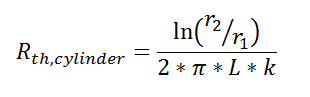
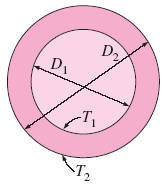
It is defined as the resistance or opposition of heat of the cylindrical layer and is a function of the radii (interior and exterior), the length and the thermal conductivity of the cylinder material.
Example: The CYLINDER CONDUCTION RESISTANCE is calculated with the quotient of the natural logarithm of the external radius divided by the internal radius, all this over twice the value of pi multiplied by the length and the conductivity of the material.
es: Resistencia a la conducción de un cilindro.
Efficiency
Noun.
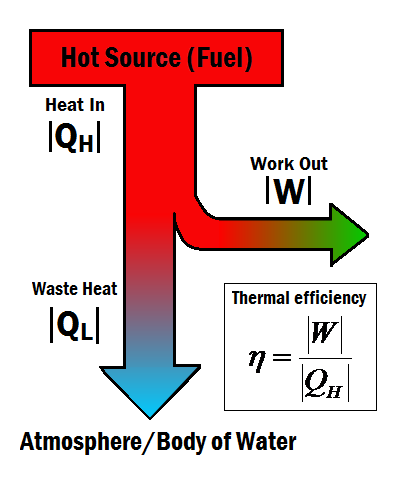
In general, the efficiency of heat exchange is defined as the ratio of the amount of heat transferred in the actual case to the amount of heat in the ideal case.
Example: The thermal EFFICIENCY of a good car engine has a value of around 20%.
es: Eficiencia.
Fin effectiveness
Noun.
Is defined as the ratio of the actual heat transfer rate through the fin base divided by the maximum possible heat transfer rate through the fin base, which can be obtained if the entire fin is at base temperature (i.e., its material thermal conductivity is infinite).
Example: An FIN EFFECTIVENESS greater than one indicates that the fins are improving heat transfer from the surface.
es: Efectividad de la aleta.
Fin efficiency
Noun.
Is defined as the ratio of actual heat flow of the fin to that which would be obtained with a fin of constant temperature uniformly equal to the base surface temperature, that is, one with infinite thermal conductivity.
Example: FIN EFFICIENCY in practice is above 90%.
es: Eficiencia de la aleta.
Interface resistance
Noun.
It is the opposition to heat flow caused by imperfect contact at an interface and is a function of contact thermal conductance and contact area.
Example: The most common in a network of thermal resistances is that it is formed by the resistance of a plate, the resistance to convection and the INTERFACE RESISTANCE.
es: Resistencia de la interfase.
Plane wall conduction resistance
Noun.
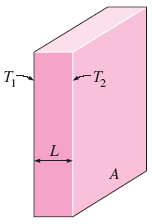
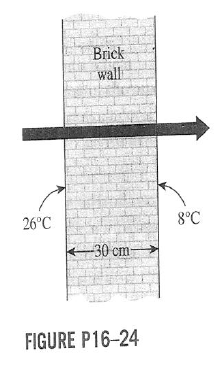
The thermal resistance to the conduction of a flat wall is the opposition of a wall of a certain material to the conduction of heat through it and is measured in degrees Celsius per Watt (° C / W), it is obtained by dividing the length of the wall on the product of thermal conductivity and the area of the plate.
Example: The PLANE WALL CONDUCTION RESISTANCE of concrete 3 meters long by 2 meters high is 0.016 ° C / W.
es: Resistencia a la conducción de la pared plana.
Radiation resistance
Noun.
It is the opposition to radiative heat flow from a surface and depends on the surface area and the radiative heat transfer coefficient.
Example: The units of RADIATION RESISTANCE are given in Kelvin per Watts (K / W).
es: Resistencia a la radiación.
Sphere conduction resistance
Noun.
It is the opposition of the spherical layer against the conduction of heat and is a function of the radii of the sphere, as well as the thermal conductivity.
Example: SPHERE CONDUCTION RESISTANCE is calculated as the quotient of the radius difference divided by the product of four times pi multiplied by the radii and the thermal conductivity constant of the material.
es: Resistencia a la conducción de la capa esférica.
Surfaces
Noun.
As the term is most generally used, is the outermost or uppermost layer of a physical object or space. It is the portion or region of the object that can first be perceived by an observer.
Example: The side wall of a house has two SURFACES one external and one internal.
es: Superficies.
Thermal contact conductance
Noun.
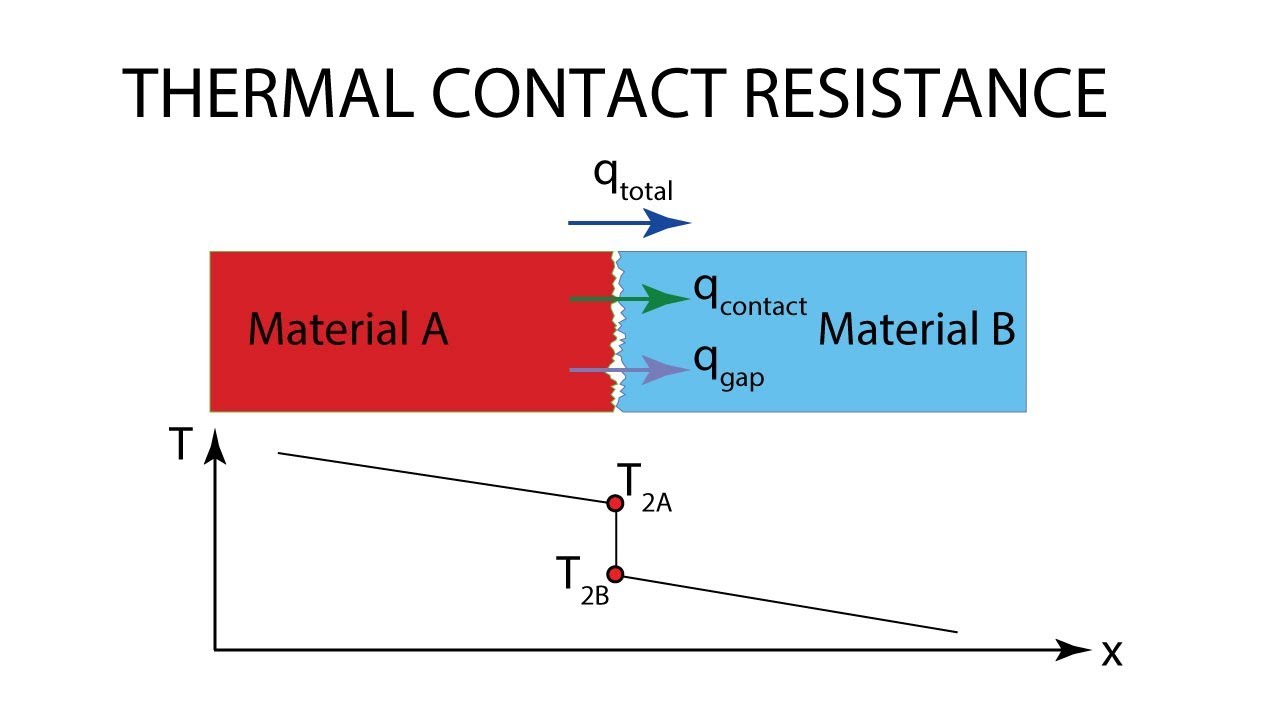
Is the study of heat conduction between solid bodies in thermal contact. The thermal contact conductance coefficient, "hc", is a property indicating the thermal conductivity, or ability to conduct heat, between two bodies in contact.
Example: The units in which THERMAL CONTACT CONDUCTANCE is expressed are (W / m ^ 2 • ° C).
es: Conductancia térmica por contacto.
Thermal contact resistance
Noun.
Thermal contact resistance is defined as the ratio between this temperature drop and the average heat flow across the interface. Also thermal contact resistance is defined as the inverse of thermal contact conductance.
Example: As the THERMAL CONTACT RESISTANCE is the inverse of the thermal contact conductance, the units of the first are also the inverse of the units of the second, that is, (m^2 •°C / W).
es: Resistencia térmica por contacto.
Total thermal resistance
Noun.
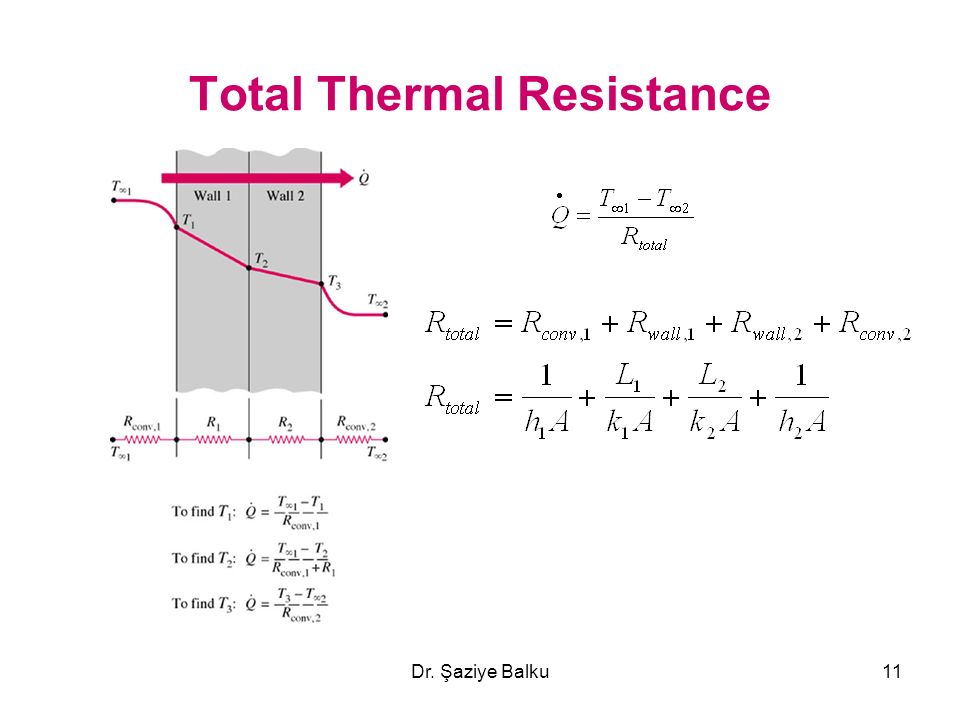
Thermal resistance is the ability of a material to oppose the flow of heat, when we speak of total thermal resistance it refers to the sum of the resistance to conduction and resistance to convection on both sides of a wall.
Example: A part of the TOTAL THERMAL RESISTANCE is the conduction resistance, which is obtained by dividing the length of the element over the product of the thermal conductivity and the area of the material.